Circles im Labyrinth
-
Ach, sorry, ich bin doof...

Du hast den Kapillareffekt ja bereits perfekt umgesetzt... danke.
-
Ja, aber läuft nicht wirklich perfekt. Je nach Höhe und Breite des Zylinder und ab einer bestimmten Anzahl der Kreise fangen sie an zu sich zu überlappen und zu tunneln.
-
Ich bin mir unsicher, aber ich glaube, du musst das über die Energie machen. Durch das Befüllen gewinnt das "System" an potentieller Energie. Dadurch wird in kinetische Enegie umgewandelt und die Kreise steigen im Labyrinth langsam auf, bis wieder ein energetisches Minimum (Gleichgewicht) erreicht ist.
... Ok, das war Quatsch ... Habe es mal nachgelesen, du müsstest für jeden Kreis Kohäsion, Adhäsion und Gravitation (Konstante) speichern, die Summe der Kräfte auf einen Kreis lässt sich dann über das Lennard-Jones-Potential berechnen: F_gesamt=F_Gravitation+F_Adhäsion+F_Kohäsion. Die Bewegung (Beschleunigung) eines Kreis' dann über die Newtonschen Gesetze: a=F/m.
Wenn ich das richtig sehe, hast du das in
zp::physicsaber schon?
-
Ok, du hast da vermutlich eine quadratische oder polynomielle Laufzeit, was bei vielen Kreisen (Partikeln) schnell problematisch werden kann.
In jedem Simulationsschritt müsstest du für jeden Kreis berechnen (Schleife):
- Wurde dieser Kreis bereits bewegt? -> Überspringen.
- Wohin soll er sich bewegen? Soll er sich nicht bewegen? -> Überspringen.
- Ist er umgeben oder frei? -> Umgeben: Überspringen.
- Wird durch Bewegen kein anderer frei? -> Überspringen.
- Gibt es eine Überschneidung durch Bewegen? -> Überspringen.
- Aktion: Bewegen und als bewegt kennzeichnen, Schleife von Anfang(!) durchlaufen.
Abbruch: Nach allen(!) Schritten wurde kein Kreis bewegt.
Edit: Ahh, ich sehe gerade, die Downvotes gehen wieder los.

-
Ich denke, ich brauch da einen ganz neuen Ansatz. Im Moment ist er Impuls basiert und da gibt es halt Grenzen. Man könnte noch mit den Konstanten spielen, um noch etwas rauszuholen.
-
Jap, neuer Ansatz

Kreise, die sich überlappen bzw. überschneiden, sind einfach doof... oder sagen wir, nicht realitätsnah genug
-
Habe schon einige Macken in meinem Code gesehen, die mir vielleicht gar nicht aufgefallen wären, hätte ich ihn hier nicht gepostet...
-
@zeropage
Ich habe mal kurz über deinen Code überflogen und es sieht recht ordentlich aus. Eine Sache muss ich jedoch anmerken:constexpr bool isGenerating() const { return m_IsGenerating; }
constexpr bool& isGenerating() { return m_IsGenerating; }Das erinnert mich an meine, leider unbelehrbare, Arbeitskollegin welche primitive Datentypen generell per Referenz zurückgibt. Erst neulich sah ich dann noch ein volatile herumschwirren.
Jedenfalls würde ich dir empfehlen die Funktion
constexpr bool& isGenerating() { return m_IsGenerating; }komplett zu löschen, da redundant.Auch die Funktion
constexpr f32& generationDelay() { return m_GenerationDelay; }sieht verdächtig aus.
-
Mir ist noch ein technisches Detail aufgefallen:
					// North neighbour
					if (m_CellStack.top().Y > 0 && (cellOffset(0, -1) & CELL_VISITED) == 0)
						neighbours.push_back(0);
					// East neighbour
					if (m_CellStack.top().X < m_MazeArray.width() - 1 && (cellOffset(1, 0) & CELL_VISITED) == 0)
						neighbours.push_back(1);
					// South neighbour
					if (m_CellStack.top().Y < m_MazeArray.height() - 1 && (cellOffset(0, 1) & CELL_VISITED) == 0)
						neighbours.push_back(2);
					// West neighbour
					if (m_CellStack.top().X > 0 && (cellOffset(-1, 0) & CELL_VISITED) == 0)
						neighbours.push_back(3);
// Draw Cell if (m_MazeArray(x, y) & CELL_VISITED) e.draw().fillRectangle(cellPos, ivec2(m_PathWidth, m_PathWidth), m_Color.Visited); else e.draw().fillRectangle(cellPos, ivec2(m_PathWidth, m_PathWidth), m_Color.Free); // Draw passageways between cells if (m_MazeArray(x, y) & CELL_PATH_S) // South e.draw().fillRectangle( ivec2(cellPos.x, cellPos.y + m_PathWidth), ivec2(m_PathWidth, m_CellStride - m_PathWidth), m_Color.Visited); if (m_MazeArray(x, y) & CELL_PATH_E) // EastDu willst/solltest hier, an den 7 Vorkommen, nicht
&sondern den kurzschließenden Op&&verwenden... minimaler Geschwindkeitszuwachs.Ich habe aus deiner C++Anwendung mal HTML/JS gemacht, weil ich hier keinen C-Compiler habe, und das mal ausprobieren wollte... leider sehr langsam. Die Algorithmen habe ich dabei nicht geändert:
<!DOCTYPE html> <html lang="en"> <head> <meta charset="UTF-8"> <meta name="viewport" content="width=device-width, initial-scale=1"> <title>Maze and Circles Simulation</title> <style> :root { color-scheme: dark; font-family: system-ui, sans-serif; background: #16202a; color: #e8f0f5; } body { margin: 0; padding: 1rem; min-height: 100vh; box-sizing: border-box; } main { max-width: 1160px; margin: 0 auto; } h1 { margin: 0 0 .35rem; font-size: 1.35rem; } p { margin: 0 0 .8rem; color: #b9cbd5; } .canvas-wrap { overflow: auto; border: 1px solid #334b5a; background: #9dd8ee; box-shadow: 0 8px 24px #0005; } canvas { display: block; width: 900px; height: 760px; max-width: 100%; margin: 0 auto; cursor: crosshair; touch-action: none; } .controls { display: flex; flex-wrap: wrap; gap: .55rem 1.25rem; margin-top: .8rem; padding: .7rem .85rem; border: 1px solid #334b5a; background: #1d2b36; color: #c8d8df; font-size: .92rem; } button { border: 1px solid #668394; border-radius: .25rem; padding: .2rem .7rem; background: #29414f; color: inherit; cursor: pointer; } button:hover { background: #355769; } </style> </head> <body> <main> <h1>Maze and circles</h1> <p>Wait for the maze to finish, then hold the left mouse button (or touch) to drop circles.</p> <div class="canvas-wrap"> <canvas id="simulation" width="900" height="760" aria-label="Maze and circles physics simulation"></canvas> </div> <div class="controls"> <span><strong>Left/right:</strong> generation delay</span> <span><strong>Enter:</strong> reset</span> <button id="reset" type="button">Reset</button> </div> </main> <script> (() => { "use strict"; const canvas = document.getElementById("simulation"); const ctx = canvas.getContext("2d"); const resetButton = document.getElementById("reset"); const WIDTH = canvas.width; const HEIGHT = canvas.height; const EPSILON = 0.0001; const GRAVITY = {x: 0, y: 9.81 * 2}; const ITERATIONS = 2; const SUBSTEPS = 6; const MAX_STEP_DISPLACEMENT = 3; const MAX_CORRECTION = 2; const WALL_RESTITUTION = 0.25; const CIRCLE_RESTITUTION = 0.20; const CIRCLE_MASS = 10; const CIRCLE_DAMPING = 0.5; const CIRCLE_RADIUS = 4; const WALL_RADIUS = 1; const CELL_PATH_N = 0x01; const CELL_PATH_E = 0x02; const CELL_PATH_S = 0x04; const CELL_PATH_W = 0x08; const CELL_VISITED = 0x10; const maze = { width: 12, height: 16, pathWidth: 35, pathGap: 2, position: {x: 170, y: 100}, cells: [], stack: [], visited: 0, generating: false, generationDelay: 0, delayTimer: 0, get stride() { return this.pathWidth + this.pathGap; }, get totalWidth() { return this.width * this.stride; }, get totalHeight() { return this.height * this.stride; }, reset() { this.cells = new Array(this.width * this.height).fill(0); this.stack = []; this.visited = 0; this.delayTimer = 0; const x = Math.floor(Math.random() * this.width); const y = Math.floor(Math.random() * this.height); this.stack.push({x, y}); this.cell(x, y).value |= CELL_VISITED; this.visited = 1; this.generating = true; }, index(x, y) { return y * this.width + x; }, cell(x, y) { const index = this.index(x, y); return { get value() { return maze.cells[index]; }, set value(value) { maze.cells[index] = value; } }; }, generate(dt) { if (!this.generating) { return false; } this.delayTimer += dt; if (this.generationDelay > 0 && this.delayTimer < this.generationDelay) { return false; } this.delayTimer = 0; if (this.visited >= this.cells.length) { this.generating = false; return true; } const current = this.stack[this.stack.length - 1]; const neighbours = []; if (current.y > 0 && !(this.cell(current.x, current.y - 1).value && CELL_VISITED)) { neighbours.push(0); } if (current.x < this.width - 1 && !(this.cell(current.x + 1, current.y).value && CELL_VISITED)) { neighbours.push(1); } if (current.y < this.height - 1 && !(this.cell(current.x, current.y + 1).value && CELL_VISITED)) { neighbours.push(2); } if (current.x > 0 && !(this.cell(current.x - 1, current.y).value && CELL_VISITED)) { neighbours.push(3); } if (neighbours.length === 0) { this.stack.pop(); } else { const direction = neighbours[Math.floor(Math.random() * neighbours.length)]; let next; if (direction === 0) { this.cell(current.x, current.y - 1).value |= CELL_VISITED | CELL_PATH_S; this.cell(current.x, current.y).value |= CELL_PATH_N; next = {x: current.x, y: current.y - 1}; } else if (direction === 1) { this.cell(current.x + 1, current.y).value |= CELL_VISITED | CELL_PATH_W; this.cell(current.x, current.y).value |= CELL_PATH_E; next = {x: current.x + 1, y: current.y}; } else if (direction === 2) { this.cell(current.x, current.y + 1).value |= CELL_VISITED | CELL_PATH_N; this.cell(current.x, current.y).value |= CELL_PATH_S; next = {x: current.x, y: current.y + 1}; } else { this.cell(current.x - 1, current.y).value |= CELL_VISITED | CELL_PATH_E; this.cell(current.x, current.y).value |= CELL_PATH_W; next = {x: current.x - 1, y: current.y}; } this.stack.push(next); this.visited++; } return false; } }; const physics = { circles: [], walls: [], reset() { this.circles = []; this.walls = []; }, createCircle(pos, radius) { if (!(radius > 0)) { return; } this.circles.push({ pos: {x: pos.x, y: pos.y}, vel: {x: 0, y: 0}, radius, fill: "#f28c28", frame: "#101820" }); }, createWall(start, end, radius, color) { if (radius <= 0 || Math.hypot(end.x - start.x, end.y - start.y) ** 2 < EPSILON) { return; } this.walls.push({ start: {x: start.x, y: start.y}, end: {x: end.x, y: end.y}, radius, color }); }, update(frameDt) { const dt = Math.min(frameDt, 1 / 30); for (let step = 0; step < SUBSTEPS; step++) { this.integrate(dt); this.solveCollisions(dt); } this.circles = this.circles.filter((circle) => { return circle.pos.x - circle.radius >= 0 && circle.pos.x + circle.radius <= WIDTH && circle.pos.y - circle.radius >= 0 && circle.pos.y + circle.radius <= HEIGHT; }); }, integrate(dt) { const frameDamping = Math.pow(CIRCLE_DAMPING, dt); const maxSpeed = MAX_STEP_DISPLACEMENT / dt; for (const circle of this.circles) { circle.vel.x += GRAVITY.x * dt; circle.vel.y += GRAVITY.y * dt; circle.vel.x *= frameDamping; circle.vel.y *= frameDamping; const speed = Math.hypot(circle.vel.x, circle.vel.y); if (speed > maxSpeed) { circle.vel.x *= maxSpeed / speed; circle.vel.y *= maxSpeed / speed; } circle.pos.x += circle.vel.x * dt; circle.pos.y += circle.vel.y * dt; } }, solveCollisions(dt) { const slop = 0.01; const inverseMass = 1 / CIRCLE_MASS; const inverseMassSum = inverseMass + inverseMass; const restThreshold = 2 * Math.hypot(GRAVITY.x, GRAVITY.y) * dt; for (let iteration = 0; iteration < ITERATIONS; iteration++) { for (let i = 0; i < this.circles.length; i++) { for (let j = i + 1; j < this.circles.length; j++) { const a = this.circles[i]; const b = this.circles[j]; const delta = {x: b.pos.x - a.pos.x, y: b.pos.y - a.pos.y}; const radiusSum = a.radius + b.radius; const distanceSquared = delta.x * delta.x + delta.y * delta.y; if (distanceSquared >= radiusSum * radiusSum) { continue; } let distance = Math.sqrt(distanceSquared); let normal; if (distance < EPSILON) { const theta = ((i * 31 + j * 17) % 360) * Math.PI * 2 / 360; normal = {x: Math.cos(theta), y: Math.sin(theta)}; distance = 0; } else { normal = {x: delta.x / distance, y: delta.y / distance}; } const penetration = radiusSum - distance; const correction = Math.min(Math.max(penetration - slop, 0), MAX_CORRECTION) / inverseMassSum; a.pos.x -= normal.x * correction * inverseMass; a.pos.y -= normal.y * correction * inverseMass; b.pos.x += normal.x * correction * inverseMass; b.pos.y += normal.y * correction * inverseMass; } } for (const circle of this.circles) { for (const wall of this.walls) { const wallVector = { x: wall.end.x - wall.start.x, y: wall.end.y - wall.start.y }; const wallLengthSquared = wallVector.x * wallVector.x + wallVector.y * wallVector.y; if (wallLengthSquared < EPSILON) { continue; } const toCircle = { x: circle.pos.x - wall.start.x, y: circle.pos.y - wall.start.y }; const t = Math.max(0, Math.min(1, (wallVector.x * toCircle.x + wallVector.y * toCircle.y) / wallLengthSquared)); const closest = { x: wall.start.x + wallVector.x * t, y: wall.start.y + wallVector.y * t }; const delta = {x: circle.pos.x - closest.x, y: circle.pos.y - closest.y}; const distanceSquared = delta.x * delta.x + delta.y * delta.y; const collisionRadius = circle.radius + wall.radius; if (distanceSquared >= collisionRadius * collisionRadius) { continue; } const distance = Math.sqrt(distanceSquared); const normal = contactNormal(delta, distance, wallVector); if (!normal) { continue; } circle.pos.x += normal.x * Math.max(collisionRadius - distance - slop, 0); circle.pos.y += normal.y * Math.max(collisionRadius - distance - slop, 0); } } } for (let iteration = 0; iteration < ITERATIONS; iteration++) { for (let i = 0; i < this.circles.length; i++) { for (let j = i + 1; j < this.circles.length; j++) { const a = this.circles[i]; const b = this.circles[j]; const delta = {x: b.pos.x - a.pos.x, y: b.pos.y - a.pos.y}; const distanceSquared = delta.x * delta.x + delta.y * delta.y; const radiusSum = a.radius + b.radius; if (distanceSquared > radiusSum * radiusSum) { continue; } const distance = Math.sqrt(distanceSquared); if (distance < EPSILON) { continue; } const normal = {x: delta.x / distance, y: delta.y / distance}; const relativeVelocity = { x: b.vel.x - a.vel.x, y: b.vel.y - a.vel.y }; const velocityAlongNormal = relativeVelocity.x * normal.x + relativeVelocity.y * normal.y; if (velocityAlongNormal >= 0) { continue; } const restitution = -velocityAlongNormal < restThreshold ? 0 : CIRCLE_RESTITUTION; const impulseMagnitude = -(1 + restitution) * velocityAlongNormal / inverseMassSum; const impulse = { x: normal.x * impulseMagnitude, y: normal.y * impulseMagnitude }; a.vel.x -= impulse.x * inverseMass; a.vel.y -= impulse.y * inverseMass; b.vel.x += impulse.x * inverseMass; b.vel.y += impulse.y * inverseMass; } } for (const circle of this.circles) { for (const wall of this.walls) { const wallVector = { x: wall.end.x - wall.start.x, y: wall.end.y - wall.start.y }; const wallLengthSquared = wallVector.x * wallVector.x + wallVector.y * wallVector.y; if (wallLengthSquared < EPSILON) { continue; } const toCircle = { x: circle.pos.x - wall.start.x, y: circle.pos.y - wall.start.y }; const t = Math.max(0, Math.min(1, (wallVector.x * toCircle.x + wallVector.y * toCircle.y) / wallLengthSquared)); const closest = { x: wall.start.x + wallVector.x * t, y: wall.start.y + wallVector.y * t }; const delta = {x: circle.pos.x - closest.x, y: circle.pos.y - closest.y}; const collisionRadius = circle.radius + wall.radius; const distance = Math.hypot(delta.x, delta.y); if (distance * distance > collisionRadius * collisionRadius) { continue; } const normal = contactNormal(delta, distance, wallVector); if (!normal) { continue; } const velocityAlongNormal = circle.vel.x * normal.x + circle.vel.y * normal.y; if (velocityAlongNormal >= 0) { continue; } const restitution = -velocityAlongNormal < restThreshold ? 0 : WALL_RESTITUTION; circle.vel.x -= normal.x * ((1 + restitution) * velocityAlongNormal); circle.vel.y -= normal.y * ((1 + restitution) * velocityAlongNormal); } } } } }; function contactNormal(delta, distance, wallVector) { if (distance > EPSILON) { return {x: delta.x / distance, y: delta.y / distance}; } const perpendicular = {x: -wallVector.y, y: wallVector.x}; const length = Math.hypot(perpendicular.x, perpendicular.y); if (length < EPSILON) { return null; } return {x: perpendicular.x / length, y: perpendicular.y / length}; } function addWall(x0, y0, x1, y1) { physics.createWall({x: x0, y: y0}, {x: x1, y: y1}, WALL_RADIUS, "rgba(0, 0, 0, .78)"); } function createOuterWalls() { const outerGap = 50; addWall(maze.position.x - 1, maze.position.y - outerGap, maze.position.x - 1, maze.position.y); addWall(maze.position.x - 1 + maze.totalWidth, maze.position.y - outerGap, maze.position.x - 1 + maze.totalWidth, maze.totalHeight + outerGap + 11); } function exportMazeWalls() { for (let y = 0; y < maze.height - 1; y++) { for (let x = 0; x < maze.width; x++) { const x0 = x * maze.stride + maze.position.x - maze.pathGap / 2; const y0 = y * maze.stride + maze.position.y - maze.pathGap / 2; const x1 = x0 + maze.stride; const y1 = y0 + maze.stride; const value = maze.cell(x, y).value; if (value === 0) { addWall(x0, y1, x1, y1); addWall(x0, y0, x0, y1); addWall(x1, y0, x1, y1); } else if (value === 1) { addWall(x1, y0, x1, y1); } else if (value === 2) { addWall(x0, y0, x0, y1); addWall(x1, y0, x1, y1); } else if (value >= 17 && value <= 19) { addWall(x0, y1, x1, y1); addWall(x0, y0, x0, y1); } else if (value >= 20 && value <= 23) { addWall(x0, y0, x0, y1); } else if (value >= 24 && value <= 27) { addWall(x0, y1, x1, y1); } } } } function drawMaze() { const xStart = maze.position.x; const yStart = maze.position.y; ctx.fillStyle = "#071016"; ctx.fillRect(xStart, yStart, maze.totalWidth, (maze.height - 1) * maze.stride - maze.pathGap); for (let y = 0; y < maze.height - 1; y++) { for (let x = 0; x < maze.width; x++) { const cell = maze.cell(x, y); const cellX = xStart + x * maze.stride; const cellY = yStart + y * maze.stride; ctx.fillStyle = cell.value && CELL_VISITED ? "rgba(160, 220, 240, .62)" : "rgba(0, 0, 0, .78)"; ctx.fillRect(cellX, cellY, maze.pathWidth, maze.pathWidth); if (cell.value && CELL_PATH_S) { ctx.fillRect(cellX, cellY + maze.pathWidth, maze.pathWidth, maze.pathGap); } if (cell.value && CELL_PATH_E) { ctx.fillRect(cellX + maze.pathWidth, cellY, maze.pathGap, maze.pathWidth); } } } if (maze.generating && maze.stack.length > 0 && maze.stack[maze.stack.length - 1].y < maze.height - 1) { const current = maze.stack[maze.stack.length - 1]; ctx.fillStyle = "#ffffff"; ctx.fillRect(xStart + current.x * maze.stride, yStart + current.y * maze.stride, maze.pathWidth, maze.pathWidth); } } function drawWalls() { ctx.save(); ctx.lineWidth = WALL_RADIUS * 2; ctx.lineCap = "round"; ctx.strokeStyle = "rgba(0, 0, 0, .78)"; for (const wall of physics.walls) { ctx.beginPath(); ctx.moveTo(wall.start.x, wall.start.y); ctx.lineTo(wall.end.x, wall.end.y); ctx.stroke(); } ctx.restore(); } function drawCircles() { for (const circle of physics.circles) { ctx.beginPath(); ctx.arc(circle.pos.x, circle.pos.y, circle.radius, 0, Math.PI * 2); ctx.fillStyle = circle.fill; ctx.fill(); ctx.strokeStyle = circle.frame; ctx.lineWidth = 1; ctx.stroke(); const speed = Math.hypot(circle.vel.x, circle.vel.y); if (circle.radius > 2) { ctx.beginPath(); if (speed > EPSILON) { ctx.moveTo(circle.pos.x, circle.pos.y); ctx.lineTo(circle.pos.x + circle.vel.x / speed * circle.radius, circle.pos.y + circle.vel.y / speed * circle.radius); } else { ctx.arc(circle.pos.x, circle.pos.y, .5, 0, Math.PI * 2); } ctx.strokeStyle = circle.frame; ctx.stroke(); } } } function drawInfo() { const x = maze.position.x + maze.totalWidth + 40; let y = maze.position.y + 30; ctx.fillStyle = "rgba(110, 0, 0, .86)"; ctx.font = "18px system-ui, sans-serif"; ctx.textBaseline = "top"; ctx.fillText("Maze size:", x, y); ctx.fillText(`${maze.width}, ${maze.height}`, x + 190, y); y += 22; ctx.fillText("Maze cells:", x, y); ctx.fillText(String(maze.cells.length), x + 190, y); y += 22; if (maze.generating) { ctx.fillText("Generation delay:", x, y); ctx.fillText(`${maze.generationDelay.toFixed(2)} s`, x + 190, y); } y += 52; ctx.font = "24px system-ui, sans-serif"; ctx.fillStyle = "rgba(110, 0, 0, .9)"; ctx.fillText(maze.generating ? "Generating maze" : "Drop circles with mouse", x, y); y += 52; ctx.font = "18px system-ui, sans-serif"; ctx.fillText("Circle count:", x, y); ctx.fillText(String(physics.circles.length), x + 200, y); } let mazePhysicsReady = false; let pointerActive = false; let pointerPosition = {x: 0, y: 0}; let spawnTimer = 0; const keys = new Set(); function reset() { physics.reset(); createOuterWalls(); maze.reset(); mazePhysicsReady = false; spawnTimer = 0; } function pointerToCanvas(event) { const rect = canvas.getBoundingClientRect(); return { x: (event.clientX - rect.left) * WIDTH / rect.width, y: (event.clientY - rect.top) * HEIGHT / rect.height }; } function dropCircles() { for (let i = 0; i < 3; i++) { physics.createCircle(pointerPosition, CIRCLE_RADIUS); } } canvas.addEventListener("pointerdown", (event) => { pointerActive = true; pointerPosition = pointerToCanvas(event); canvas.setPointerCapture(event.pointerId); if (!maze.generating) { dropCircles(); } }); canvas.addEventListener("pointermove", (event) => { pointerPosition = pointerToCanvas(event); }); canvas.addEventListener("pointerup", () => { pointerActive = false; }); canvas.addEventListener("pointercancel", () => { pointerActive = false; }); window.addEventListener("blur", () => { pointerActive = false; keys.clear(); }); window.addEventListener("keydown", (event) => { if (event.key === "Enter") { reset(); } if (event.key === "ArrowLeft" || event.key === "ArrowRight") { event.preventDefault(); keys.add(event.key); } }); window.addEventListener("keyup", (event) => { keys.delete(event.key); }); resetButton.addEventListener("click", reset); function frame(timestamp) { if (!frame.lastTimestamp) { frame.lastTimestamp = timestamp; } const dt = Math.min((timestamp - frame.lastTimestamp) / 1000, 0.1); frame.lastTimestamp = timestamp; if (keys.has("ArrowLeft")) { maze.generationDelay -= dt; } if (keys.has("ArrowRight")) { maze.generationDelay += dt; } maze.generationDelay = Math.max(0, maze.generationDelay); const becameReady = maze.generate(dt); if (becameReady || (!maze.generating && !mazePhysicsReady)) { exportMazeWalls(); mazePhysicsReady = true; } if (!maze.generating && pointerActive) { spawnTimer += dt; if (spawnTimer >= 0.05) { spawnTimer = 0; dropCircles(); } } else { spawnTimer = 0; } physics.update(dt); ctx.clearRect(0, 0, WIDTH, HEIGHT); drawMaze(); if (!maze.generating) { drawWalls(); } drawCircles(); drawInfo(); requestAnimationFrame(frame); } reset(); requestAnimationFrame(frame); })(); </script> </body> </html>Dabei ist mir noch aufgefallen, dass sich Kreise nicht nur überschneiden, sondern sogar durch Wände rutschen können... fast schon gespenstisch.

-
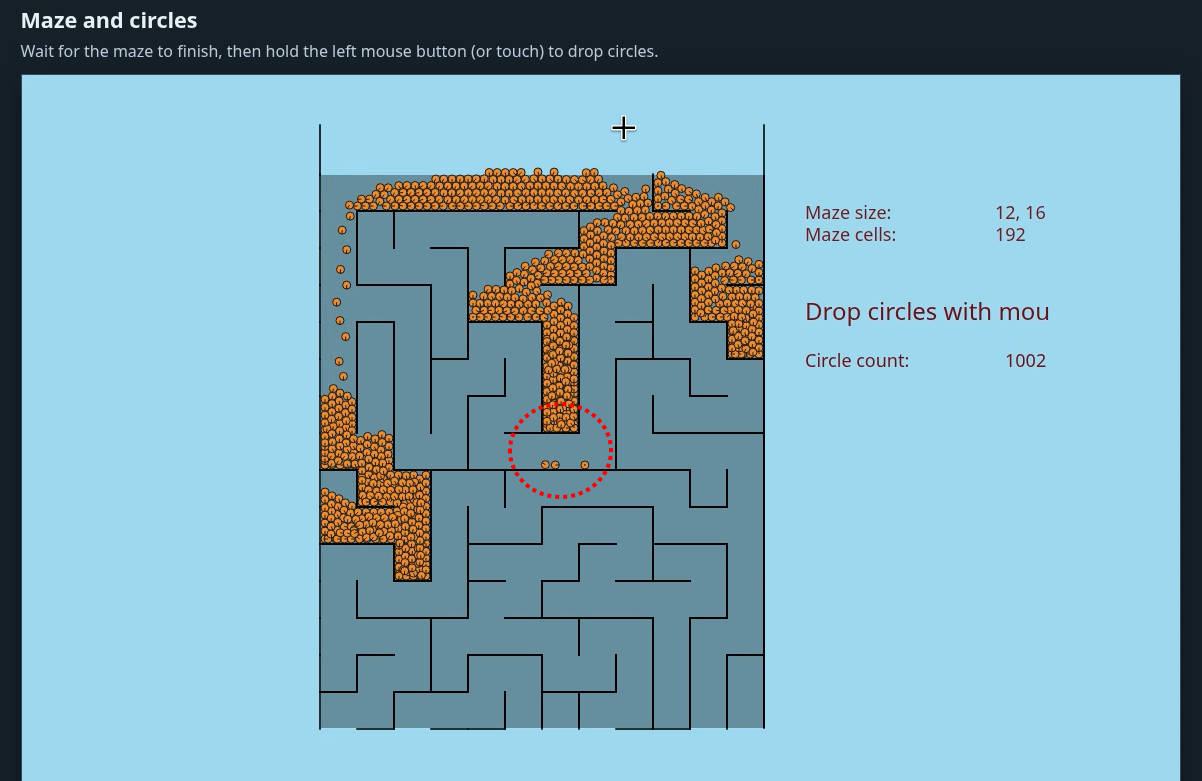
Man kann das hier an den drei in Rot markierten Kreisen erkennen, diese sind durch die obige Wand "gerutscht".

Auf der linken Seite ist der Kapillareffekt erkennbar, Kreise steigen auch auf (entgegen der Schwerkraft), aber dieser Effekt ist noch zu träge...
-
@Quiche-Lorraine Tatsächlich! Danke.
-
@Anon-81275 Das habe ich doch beschrieben, das Kreise je nach Säule und Anzahl noch tunneln können. Das wurde aber gegenüber meinen früheren Versionen stark verbessert.
Aber danke, das Du das übersetzt hast